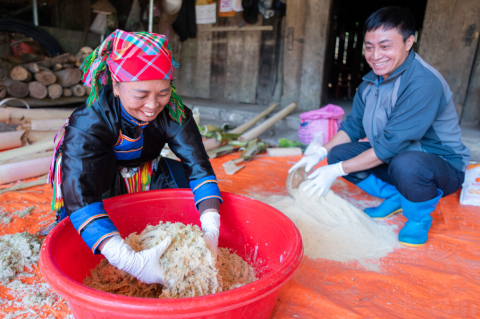
ACB, KfW project improves livelihood and conservation efforts in Viet Nam
From 17 to 30 November, the ASEAN Centre for Biodiversity (ACB), led by the Small Grants Programme by the ASEAN Centre for Biodiversity II (SGP II) team, along with representatives from the KfW Development Bank (KfW), GITEC IGIP GmbH, and SGP II service providers in Viet Nam, conducted a series of missions to assess the programme’s contributions to biodiversity conservation and sustainable livelihoods in and around selected ASEAN Heritage Parks (AHPs).
“We cannot simply ask the communities to cease extracting resources from the wild. They have to provide for their families. We should offer them alternative livelihood opportunities that are viable, sustainable, and biodiversity-friendly. That is how we transform communities from consumers to custodians of biological resources through the SGP,” said Dr. Jerome Montemayor, executive director of the ASEAN Centre for Biodiversity.
Through the SGP II, 40 park staff from the Kon Ka Kinh National Park (KKKNP) were supported with capacity building activities to strengthen wildlife monitoring of key primate and ungulate species—including the Grey-shanked douc langur, Northern yellow-cheeked crested gibbon, and Truong son muntjac—using 14 camera traps and other essential equipment provided under the programme.
“Since the cooperative provided me with beehives, I have no longer gone into the forest to collect wild honey, because it required climbing large tree branches and was very dangerous. I stay at home to take care of these beehives, as they have created additional income for my family’s livelihood, and gradually I have come to love and develop a passion for these bees,” said Mr. Ho Quoc Viet, a member of the Sa Thay Commune Beekeeping Cooperative.
Biodiversity conservation and sustainable livelihood development were also one of the highlights of SGP II in Ba Be National Park and Hoang Lien National Park (HLNP). Leveraging iconic landscapes such as Ba Be Lake and Mt. Fansipan, SGP II supported ecotourism-focused projects that improved park facilities and use of visibility materials to attract more visitors.
From three tourism routes, the programme also contributed to introducing five new routes in HLNP, enabling the park management to apply for recognition as a provincial-level tourist area—an important step towards increasing the number of visitors and the park’s revenue.
Through the simultaneous missions conducted in November 2025, best practices, challenges, lessons, and achievements were documented through group discussions, one-on-one interviews, and photo and video materials.